
How Does Heat Setting Affect Spacer Mesh Fabric Quality?

Heat setting is one of the most important finishing processes for spacer mesh fabric because it directly influences fabric width, weight, thickness, surface appearance and dimensional stability.
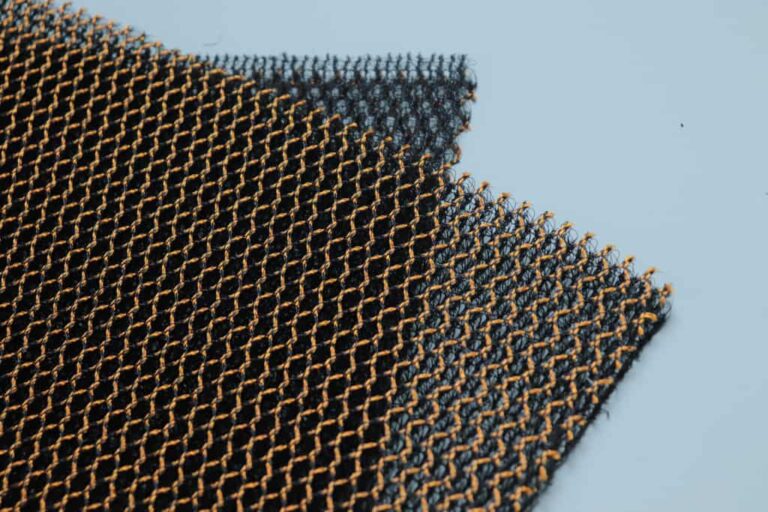
For warp-knitted spacer mesh, heat setting is not simply a matter of applying high temperatures. The fabric has a three-dimensional structure consisting of two outer surfaces connected by spacer yarns. Maintaining this structure while achieving the required dimensions requires coordinated control of several production parameters.
At Mefiss Textile, we treat heat setting as an important part of spacer mesh quality control. Different fabric constructions require different processing conditions, and each fabric has its own technical production instructions.
In this article, we explain how the heat-setting process works, which parameters influence the finished fabric, and what buyers should understand when developing custom spacer mesh materials.
1|What Is Heat Setting in Spacer Mesh Fabric Production?
Heat setting is a finishing process that uses controlled heat and fabric tension to stabilize the textile structure and achieve the required finished dimensions.
For warp-knitted spacer mesh, the process is particularly important because the fabric contains three-dimensional connecting yarns between its upper and lower surfaces.
After knitting, the fabric still needs finishing to achieve its intended width, thickness, surface appearance and dimensional stability.
The main purposes of heat setting include:
- Width control: Achieving the required finished fabric width.
- Weight adjustment: Influencing the weight per unit area through width and length control.
- Thickness control: Helping maintain the intended three-dimensional fabric structure.
- Surface appearance: Improving fabric flatness and mesh consistency.
- Dimensional stability: Reducing the risk of subsequent shrinkage and deformation.
These factors are closely related. A change in the setting conditions may influence several fabric properties at the same time.
For buyers sourcing spacer mesh fabric, understanding this relationship is useful when specifying finished width, GSM and thickness.
2|The Heat Setting Process: From Greige Fabric to Finished Material
Heat setting is part of a wider finishing and quality-control process. At Mefiss Textile, the production procedure includes greige fabric inspection, fabric relaxation, machine adjustment, heat setting, cooling and final inspection.
2.1|Greige Fabric Inspection
Before finishing, the knitted greige fabric undergoes an initial inspection.
The inspection focuses on potential defects such as:
- Holes and damaged areas.
- Broken yarns.
- Missed stitches.
- Uneven mesh structures.
- Oil stains and surface contamination.
Only fabric that passes the required inspection proceeds to the next production stage.
Early inspection helps identify knitting defects before additional finishing costs are incurred.
2.2|Fabric Relaxation Before Heat Setting
Before entering the heat-setting machine, the greige fabric is unwound and allowed to relax.
At Mefiss Textile, our usual production arrangement is to allow approximately 12 hours of relaxation before heat setting.
This step gives the fabric time to rest after being held in a rolled condition. It also helps prepare the material for subsequent width adjustment and finishing.
For three-dimensional spacer fabrics, maintaining a suitable fabric condition before machine processing is important because the material’s structure and elasticity need to be preserved.
Mefiss Manufacturing Insight
Our usual relaxation time is approximately 12 hours. This is part of our production arrangement, not a universal setting requirement for every spacer mesh fabric. Different constructions may require different processing arrangements.
2.3|Machine Adjustment and Width Setting
After relaxation, the fabric enters the heat-setting machine.
Before processing, the production team sets the required parameters according to the target fabric specifications.
These include:
- Target fabric width.
- Overfeed ratio.
- Fabric tension.
- Machine running speed.
Width adjustment is especially important because it influences the distribution of yarns within each unit area. This can affect the finished GSM, mesh appearance and fabric thickness.
2.4|Heat Setting
During heat setting, the fabric passes through the machine under controlled heating and tension conditions.
According to our production information, the usual heat-setting temperature for spacer mesh fabric is approximately 150–180°C.
However, this is a general production reference rather than a fixed recipe for every fabric. The actual processing conditions depend on fabric construction, yarn specifications and finishing requirements.
Temperature control is important for maintaining the intended fabric properties:
- Excessively high temperature: May cause the fabric to become stiff and lose its original elasticity.
- Insufficient temperature: May result in inadequate dimensional stability and a loose fabric appearance.
Therefore, temperature must be considered together with running speed, fabric tension and overfeed.
2.5|Cooling and Fabric Collection
After passing through the heating section, the fabric needs to cool down before being collected and rolled.
This stage helps the heat-set structure stabilize. Consistent fabric tension during collection is also important to avoid unnecessary creases, pressure marks or localized deformation.
2.6|Final Inspection After Heat Setting
Once heat setting is completed, the finished fabric undergoes another inspection.
The main inspection points include:
- Finished fabric width.
- Thickness consistency.
- Mesh shape and uniformity.
- Fabric edges and potential deformation.
- Hand feel and elasticity.

3|Four Key Parameters That Influence Heat Setting Results
Heat setting is a coordinated process. Changing one parameter may influence the final performance of the fabric, which is why production conditions need to be adjusted as a complete system.
3.1|Fabric Width
Fabric width is one of the most important factors affecting finished GSM and mesh appearance.
For the same greige fabric construction, changing the finished width changes how much yarn is distributed across each square meter.
| Width Adjustment | Typical GSM Effect | Mesh Appearance |
|---|---|---|
| Narrower width | GSM tends to increase | Mesh may become narrower and more elongated |
| Wider width | GSM tends to decrease | Mesh may become flatter |
These are typical tendencies under comparable production conditions, not guaranteed results for every fabric construction.
For this reason, buyers should not specify fabric width independently from GSM, thickness and mesh appearance.
3.2|Overfeed Ratio
Overfeed refers to the relationship between the fabric feeding speed and the machine’s processing speed.
It influences the fabric’s lengthwise processing condition and can affect finished dimensions, GSM and fabric appearance.
For spacer mesh, overfeed needs to be coordinated with width adjustment and fabric tension. Excessive or insufficient settings may produce unwanted dimensional changes.
The appropriate setting depends on the fabric construction and the required finished specifications.
3.3|Fabric Tension
Fabric tension determines how the material is held and stretched during heat setting.
If the fabric is subjected to inconsistent tension, the finished material may show variations in width, thickness and surface appearance.
This is particularly important for spacer mesh because its upper and lower surfaces are connected by intermediate spacer yarns.
Excessive stretching or inconsistent tension can affect the appearance and stability of this three-dimensional construction.
3.4|Machine Running Speed
Running speed determines how quickly the fabric passes through the heating section.
Temperature and running speed need to work together to achieve the required processing conditions.
A temperature setting alone does not describe the complete heat-setting process. The time the material spends in the heating section is also relevant.
At Mefiss Textile, different fabric specifications have corresponding technical production instructions. These records include key finishing parameters such as temperature and machine speed.
4|How Does Heat Setting Affect Fabric GSM and Thickness?
GSM and thickness are two important specifications when purchasing spacer mesh fabric. Although they are related, they describe different characteristics.
GSM refers to the weight of fabric per square meter, while thickness measures the distance between the fabric’s two outer surfaces under specified measurement conditions.
Heat setting can influence both properties, but the mechanisms are different.
4.1|Why Can Finished GSM Change?
GSM is affected by how the total fabric mass is distributed over the finished area.
For example, if the same amount of fabric material is distributed over a wider area, the weight per square meter generally decreases. If the finished width becomes narrower, the GSM generally increases.
In actual production, lengthwise feeding and overfeed also influence the finished area. Therefore, both width and lengthwise processing conditions need to be considered.
4.2|Why Can Fabric Thickness Change?
Thickness is closely related to the spacer yarn structure, yarn specifications and the distance maintained between the two outer surfaces.
During finishing, the fabric’s structural condition may change. Heat setting helps stabilize the intended structure and achieve the required finished appearance.
However, thickness cannot be controlled by temperature alone. The original knitting construction and spacer yarn arrangement are equally important.
4.3|Why Should Buyers Specify Both GSM and Thickness?
Two spacer mesh fabrics can have similar GSM but different thicknesses and support characteristics.
Likewise, two fabrics with the same thickness may have different weights because of differences in yarn specifications, mesh density and construction.
For product development, we recommend confirming both specifications rather than using GSM as the only selection criterion.
Our 3D mesh fabric range and spacer mesh product collection provide different constructions for different applications.
5|How Does Mefiss Textile Maintain Production Consistency?
Consistent finished quality requires more than adjusting the machine during production. It also requires clear production records, reference samples and inspection procedures.
At Mefiss Textile, different fabric specifications have their own technical production instructions.
These records include important production information such as:
- Yarn specifications and quantities.
- Yarn threading arrangements.
- Knitting construction.
- Heat-setting temperature.
- Machine running speed.
Before bulk production, a standard sample is provided as a reference for the production team.
The sales, quality-control and production teams also communicate the customer’s requirements, including specifications, acceptable tolerances, delivery schedules and packaging instructions.
During production, quality-control personnel carry out routine inspections. Before dispatch, finished fabrics undergo final inspection and inspection records are maintained.
Mefiss Manufacturing Insight
One important part of our production management is maintaining fabric-specific process records. This allows the production team to refer to the corresponding yarn specifications, knitting arrangements and finishing parameters instead of treating every spacer mesh construction as if it required the same settings.
This approach is particularly useful for repeat orders and customized fabrics, where maintaining consistency between production batches is important.
6|What Should Buyers Confirm When Ordering Spacer Mesh Fabric?
When developing a new spacer mesh fabric, buyers should provide more than a general request for a breathable or thick material.
Clear specifications help the manufacturer identify the appropriate construction and finishing requirements.
| Specification | Information to Provide |
|---|---|
| Application | Footwear, bags, furniture, automotive or bedding |
| Fabric Width | Required finished width |
| Fabric Weight | Target GSM and acceptable tolerance |
| Thickness | Required thickness |
| Mesh Structure | Mesh shape, density and surface appearance |
| Performance | Breathability, compression recovery, support or elasticity |
| Color | Pantone reference or physical color sample |
If you already have a reference fabric, sending a physical sample is also helpful. It allows the manufacturer to understand the required structure, thickness, hand feel and appearance more accurately.
For customized spacer mesh development, you can also explore our spacer mesh product collection to understand the available fabric options.
7|FAQ: Spacer Mesh Heat Setting
7.1|What Is the Usual Heat Setting Temperature for Spacer Mesh?
According to Mefiss Textile’s production information, the usual heat-setting temperature is approximately 150–180°C. The actual setting depends on the fabric construction and production requirements.
7.2|How Long Does Spacer Mesh Need to Relax Before Heat Setting?
Our usual production arrangement allows approximately 12 hours of fabric relaxation before heat setting. This helps prepare the greige fabric for subsequent processing.
7.3|Does Heat Setting Affect Fabric GSM?
Yes. Changes in finished width and lengthwise processing conditions can influence the weight per unit area. GSM should therefore be checked after finishing rather than estimated from the greige fabric alone.
7.4|Does Heat Setting Affect Fabric Thickness?
Yes. Heat setting helps stabilize the fabric structure, but final thickness also depends on spacer yarn specifications, knitting construction and the distance between the two outer surfaces.
7.5|Can the Same Heat Setting Parameters Be Used for All Spacer Mesh Fabrics?
No. Different fabric constructions and specifications require corresponding production conditions. A single temperature or machine setting should not be applied indiscriminately to every fabric.
8|Conclusion: Heat Setting Is Essential to Spacer Mesh Quality
Heat setting plays an important role in determining the finished dimensions and overall quality of spacer mesh fabric.
Fabric width, GSM, thickness, mesh appearance and dimensional stability are closely related to the finishing process. Temperature, overfeed, fabric tension and running speed need to be coordinated to achieve the required specifications.
For buyers, understanding these factors makes it easier to communicate fabric requirements and evaluate supplier capabilities.
At Mefiss Textile, we combine warp-knitting production, fabric-specific process instructions and quality inspections to support the development and production of spacer mesh fabrics for different applications.
Looking for a Spacer Mesh Fabric Manufacturer?
Mefiss Textile specializes in warp-knitted spacer mesh and 3D mesh fabrics. We support customized development based on fabric thickness, GSM, width, color, mesh construction and application requirements.
Share your product application, target specifications or reference sample with our team. We would be glad to discuss suitable fabric solutions for your next project.
Tags
Previous
Why Does Spacer Mesh Fabric Have Color Differences Between Samples and Bulk Production?
Next
Spacer Mesh Fabric Shrinkage and Dimensional Stability: What Buyers Should Know


Leave a Reply