
Why Does Spacer Yarn Density Matter as Much as Diameter?
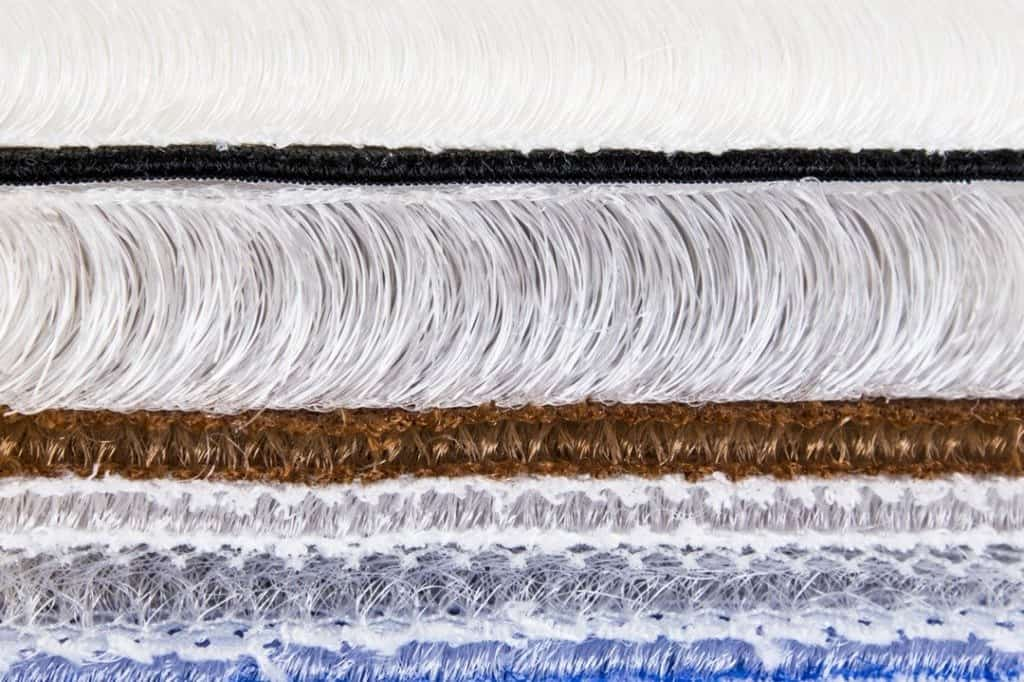
Spacer yarn density matters as much as diameter because the structural performance of 3D spacer mesh depends on both the size of individual connecting filaments and how they are distributed between the two knitted surface layers.
When developing spacer mesh fabric, manufacturers often focus on the diameter of the intermediate monofilament. However, the number and arrangement of connecting yarns also influence how the fabric maintains its thickness, responds to compression, and supports the two surface layers.
At Mefiss Textile, our production experience shows that developing thicker spacer mesh requires attention to the complete yarn construction. Increasing the size of the intermediate yarn alone does not address every structural requirement. The connecting yarn arrangement and the face and ground yarn specifications must also work together.
This article explains the relationship between spacer yarn density and diameter, introduces actual yarn specifications from Mefiss Textile, and discusses practical manufacturing considerations for different spacer mesh constructions.
1|Understanding Spacer Yarn Density and Diameter
Warp-knitted spacer mesh consists of two knitted surface layers connected by intermediate spacer yarns. These connecting yarns maintain the distance between the two layers and create the characteristic three-dimensional structure.
Although spacer yarn density and diameter are related, they describe two different structural characteristics.
1.1|What Is Spacer Yarn Diameter?
Spacer yarn diameter describes the physical thickness of an individual connecting monofilament.
In polyester spacer mesh production, the intermediate layer commonly uses monofilament yarn. Its size influences the bending behavior of the connecting filaments.
When the polymer material and cross-sectional geometry are comparable, increasing filament diameter generally increases its resistance to bending.
This is an important consideration when selecting intermediate yarn specifications for spacer mesh requiring structural support.
1.2|What Is Spacer Yarn Density?
Spacer yarn density describes how closely the connecting yarn segments are distributed within the fabric structure.
It is related to the knitting arrangement, including yarn threading and lapping movements.
A fabric with more connecting yarn segments within a defined area has a different internal construction from one with fewer connecting segments, even when both use the same monofilament specification.
Spacer yarn density should not be confused with GSM. GSM measures the total mass of the finished fabric per square meter, while connecting yarn density describes an aspect of the internal knitted construction.
For technical comparisons, density measurements should use a consistent counting method and reference area. Visual inspection alone cannot establish an accurate numerical density.
2|Why Does Spacer Yarn Density Matter When Fabric Thickness Increases?
Fabric thickness is an important consideration when selecting intermediate connecting yarns.
As the distance between the two knitted surface layers increases, the connecting yarns must span a larger internal space. Their arrangement and geometry therefore become important parts of the fabric construction.
According to Mefiss Textile’s production reference materials, thicker spacer mesh constructions may require an increase in the size or density of intermediate connecting yarns when the objective is to maintain suitable elasticity.
2.1|The Role of Thicker Connecting Yarns
A larger monofilament changes the bending behavior of each connecting yarn.
This can influence how the internal structure responds when pressure is applied. However, the finished fabric’s compression behavior also depends on yarn inclination, connecting arrangement, thickness, and the knitted surface construction.
Using a thicker monofilament does not automatically mean that the finished fabric will have better recovery or greater overall support.
2.2|The Role of Connecting Yarn Distribution
The distribution of spacer yarns determines how the connecting segments are positioned between the two surfaces.
Changing this arrangement can alter the number of supporting segments, their orientation, and the way loads are transferred through the fabric.
These structural differences are important when developing spacer mesh for cushioning, mattress support, automotive seating, and other applications requiring consistent internal support.
2.3|Why Both Factors Need to Be Considered
Spacer yarn diameter describes the size of an individual filament. Spacer yarn density describes how the connecting segments are distributed within the knitted structure.
These factors work together, but they do not produce identical effects.
For fabric development, the practical objective is to coordinate filament size, connecting arrangement, and fabric thickness rather than increasing one parameter without considering the others.
The goal is to develop a balanced internal structure, not simply to use the thickest available monofilament or the highest possible connecting yarn density.
3|Actual Spacer Yarn Specifications Used in Mefiss Textile Fabrics
Different spacer mesh constructions use different yarn specifications. Mefiss Textile’s product reference materials distinguish between lightweight spacer mesh and thicker 3D mesh constructions.
3.1|Lightweight Spacer Mesh
In our lightweight spacer mesh references, the intermediate connecting yarn commonly uses 30D/1f.
Common face and ground yarn specifications include:
- 75D/72f
- 100D/72f
- 150D/144f
The notation 30D/1f indicates a nominal linear density of 30 denier with one filament.
Denier measures the mass of yarn per 9,000 meters. It does not directly represent the physical diameter of the filament.
3.2|Thicker 3D Mesh
For thicker 3D mesh constructions, our product references include face and ground yarn specifications such as 150D, 300D, and 600D.
Intermediate monofilament specifications include:
- 10s
- 12s
- 15s
- 18s
- 25s
In Mefiss Textile’s internal product notation, 10s refers to approximately 0.10 mm monofilament diameter, while 15s refers to approximately 0.15 mm.
This internal notation is used to identify monofilament size in our product references. It should not be confused with conventional English cotton yarn count.
| Fabric Category | Face and Ground Yarn | Intermediate Yarn |
|---|---|---|
| Lightweight Spacer Mesh | 75D/72f, 100D/72f, 150D/144f | Commonly 30D/1f |
| Thicker 3D Mesh | 150D, 300D, 600D | 10s, 12s, 15s, 18s, 25s |
These specifications illustrate the different yarn systems used in our lightweight and thicker mesh constructions.
They also demonstrate why buyers should look beyond a single intermediate yarn specification when comparing spacer mesh fabrics.
Explore our Spacer Mesh Fabric Range and 3D Mesh Fabric Range for more information about our products.
4|Why Must Face and Ground Yarns Match the Spacer Yarn Construction?
The intermediate connecting yarns cannot be developed independently of the two knitted surface layers.
Face and ground yarns form the outer knitted structures. Their specifications and knitting arrangements influence how the connecting yarn loops are accommodated and covered.
According to Mefiss Textile’s production notes, when thicker intermediate yarns are used, the face and ground yarn specifications may also need to be increased.
4.1|Exposed Connecting Yarn Loops
One practical issue occurs when the intermediate monofilament becomes relatively large compared with the surrounding surface construction.
If the face and ground structures do not provide sufficient coverage, connecting yarn loops may become exposed at the fabric surface.
This can make the surface feel rougher and affect the appearance of the finished fabric.
4.2|Coordinating the Three Yarn Systems
When changing the intermediate yarn specification, manufacturers need to consider the face yarn, ground yarn, and connecting yarn as one construction.
For example, using a thicker intermediate monofilament may require corresponding adjustments to the surface yarn specifications to maintain suitable coverage.
This is particularly important when developing fabrics with specific surface appearance and hand feel requirements.
Mefiss Manufacturing Insight
In our production experience, increasing intermediate yarn size without coordinating the face and ground yarn construction can result in exposed connecting yarn loops. This is why thicker spacer mesh development involves more than selecting a larger monofilament.
5|How Does Knitting Arrangement Influence Spacer Yarn Distribution?
Yarn specifications describe the materials used in spacer mesh, but the knitting arrangement determines how those yarns form the finished structure.
Warp knitting uses guide bars, threading arrangements, and lapping movements to create the knitted layers and their connections.
In a double-needle-bar Raschel construction, the two needle beds form separate surface layers, while the connecting yarn system links them together.
5.1|Threading Arrangement
Threading determines how yarns are supplied to the guide bars and distributed across the machine width.
Different threading arrangements can create different surface structures and yarn distributions.
For example, one small-hole mesh construction in Mefiss Textile’s production references uses a three-threaded, one-empty arrangement for the face yarn system and full threading for the ground yarn system.
This is an actual face and ground threading example. It illustrates how yarn distribution can be controlled through the knitting setup, but it is not a measured specification for intermediate spacer yarn density.
5.2|Lapping Movement and Connecting Structure
Lapping movement influences the path and orientation of connecting yarns between the two needle beds.
Changes in the connecting yarn arrangement can influence the geometry of the internal structure and the way the fabric responds to compression.
For this reason, yarn specifications and knitting arrangements should be considered together during spacer mesh development.
6|What Should Manufacturers Evaluate When Developing Spacer Mesh?
When developing a new spacer mesh construction, manufacturers should evaluate the relationship between yarn specifications, knitting arrangement, and the finished fabric’s physical properties.
| Evaluation Factor | What to Check |
|---|---|
| Spacer Yarn Diameter | Monofilament size and suitability for the target structure. |
| Spacer Yarn Distribution | Connecting yarn arrangement and distribution within the fabric. |
| Fabric Thickness | Distance between the two knitted surface layers. |
| Face and Ground Yarns | Surface coverage, appearance, and compatibility with connecting yarns. |
| Knitting Arrangement | Threading, lapping, and connecting yarn geometry. |
| Finished Fabric Performance | Compression, recovery, thickness consistency, and surface quality. |
For compression-related applications, buyers should request measurements that go beyond GSM and thickness.
Useful evaluations include:
- Compression force at a defined compression level.
- Thickness retention after repeated compression.
- Recovery after the applied load is removed.
- Thickness consistency across the fabric width.
- Surface appearance and hand feel.
These measurements help distinguish fabrics that may have similar nominal specifications but different structural performance.
7|How Mefiss Textile Approaches Spacer Mesh Development
Mefiss Textile develops lightweight spacer mesh and thicker 3D mesh constructions using different yarn specifications and knitting structures.
Our production references include lightweight connecting yarn specifications such as 30D/1f and thicker mesh monofilament specifications such as 10s, 12s, 15s, 18s, and 25s.
When developing a thicker structure, our production considerations include:
- Selecting suitable intermediate monofilament specifications.
- Adjusting connecting yarn distribution for the intended construction.
- Coordinating face and ground yarn specifications.
- Controlling surface coverage to avoid exposed connecting yarn loops.
- Checking finished thickness and fabric hand feel.
These considerations are part of developing a complete knitted structure rather than simply replacing one yarn with a thicker alternative.
Buyers can explore our Spacer Mesh Product Collection and 3D Mesh Product Collection.
When discussing a spacer mesh requirement, useful information includes the target application, thickness, GSM, fabric width, surface appearance, and required compression characteristics.
These details help our team identify suitable existing constructions or discuss the feasibility of a customized fabric structure.
8|Frequently Asked Questions
8.1|Does a Thicker Spacer Yarn Always Provide Better Support?
No. A thicker monofilament changes the bending behavior of individual connecting yarns, but overall support also depends on yarn distribution, inclination, fabric thickness, and the knitted surface construction.
8.2|Can Two Spacer Mesh Fabrics with the Same Yarn Diameter Have Different Compression Properties?
Yes. Different connecting yarn arrangements and densities can produce different internal structures, which influence how the fabric responds to compression.
8.3|Is Spacer Yarn Density the Same as Fabric GSM?
No. GSM measures the total weight of the finished fabric per square meter. Spacer yarn density describes the distribution of connecting yarns within the knitted structure.
8.4|Why Can Thicker Connecting Yarns Cause a Rough Fabric Surface?
When the face and ground yarn construction does not adequately accommodate the intermediate yarn loops, those loops may become exposed at the surface and create a rougher hand feel.
8.5|What Yarn Specifications Does Mefiss Textile Use?
Our product references include 30D/1f intermediate yarn for lightweight spacer mesh and monofilament specifications such as 10s, 12s, 15s, 18s, and 25s for thicker 3D mesh constructions.
8.6|Can Mefiss Textile Develop Customized Spacer Mesh?
Yes. We can discuss customized thickness, GSM, yarn specifications, surface patterns, and internal knitted structures according to the intended application and production requirements.
Conclusion|Spacer Yarn Density and Diameter Work Together
Spacer yarn density and diameter are two important factors in 3D spacer mesh construction.
Diameter influences the behavior of individual connecting filaments, while density describes how the connecting yarns are distributed throughout the knitted structure.
For thicker spacer mesh, manufacturers also need to coordinate the intermediate yarns with the face and ground layers. This helps maintain appropriate surface coverage and avoid exposed connecting yarn loops.
At Mefiss Textile, our production experience shows that successful spacer mesh development depends on coordinating yarn specifications and knitting arrangements across the complete structure.
For buyers, comparing actual fabric construction, thickness, and compression performance provides a more useful basis for material selection than looking at monofilament diameter alone.
Looking for the Right Spacer Mesh Fabric?
Tell us about your application, target thickness, GSM, finished width, and structural requirements.
Mefiss Textile can help you explore suitable spacer mesh constructions and discuss customized fabric development.
Previous
Common Spacer Mesh Fabric Defects and How They Are Prevented
Next
How to Test Air Permeability of Spacer Mesh Fabric?
Leave a Reply