3D Spacer Mesh Weight & GSM Guide: How to Choose the Right Fabric
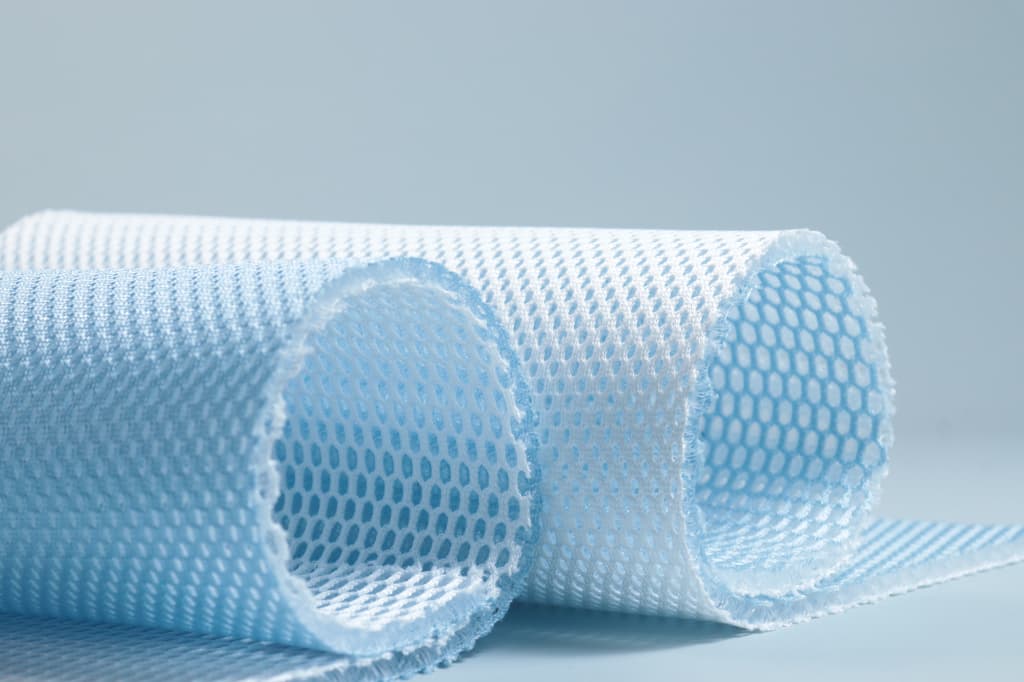
When sourcing 3D spacer mesh fabric, GSM is often one of the first specifications buyers ask about. A typical inquiry may request “500 GSM spacer mesh” or “600 GSM 3D mesh,” but GSM alone is not enough to determine whether a fabric is suitable for an application.
Two spacer fabrics with similar thicknesses can have very different weights, while two fabrics with similar GSM can differ significantly in thickness, firmness, airflow structure, and compression behavior.
At Mefiss Textile, we work with 3D spacer mesh fabrics ranging from lightweight, soft constructions to thick, high-support structures. Based on our actual fabric specifications, this guide explains how GSM should be understood and how buyers can use it together with thickness, spacer monofilament, mesh structure, and end use to select the right material.
What Does GSM Mean in 3D Spacer Mesh Fabric?
GSM means grams per square meter. It describes how much one square meter of fabric weighs.
For example:
- 300 GSM = one square meter weighs approximately 300 grams
- 600 GSM = one square meter weighs approximately 600 grams
- 1,000 GSM = one square meter weighs approximately 1 kilogram
GSM is useful for comparing the material weight of different fabrics, estimating product weight, calculating shipping quantities, and narrowing down possible constructions.
However, GSM does not directly tell you how thick, firm, breathable, or supportive a 3D spacer mesh will be.
This distinction is especially important for spacer fabrics because they are three-dimensional structures rather than conventional flat fabrics.
3D Spacer Mesh Thickness and GSM Are Not the Same Thing
A common assumption is:
The thicker the spacer mesh, the higher the GSM.
There is often some relationship between thickness and weight, but it is not a fixed or linear relationship.
Consider several examples from our actual Mefiss 3D mesh fabric range:
Mefiss Product Thickness Weight Face / Spacer Code Construction
T2D-4P 5.9 mm 620 GSM 300D face, 16S spacer monofilament
T2D-1R 10.3 mm 830 GSM 300D face, 18S spacer monofilament
T2D-2N6P 14.3 mm 310 GSM Monofilament construction
T2S-2A 20.1 mm 1,350 GSM 900D face, 26S spacer monofilament
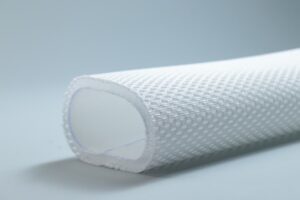
For example, Mefiss T2D-2N6P is 14.3 mm thick but weighs only 310 GSM, while Mefiss T2D-1R is thinner at 10.3 mm yet weighs 830 GSM.
Why?
Because thickness tells us how tall the spacer structure is, while GSM tells us how much material is used within one square meter.
The internal construction can be very different.
Why Can a Thick 3D Mesh Have a Low GSM?
Mefiss product T2D-2N6P is a useful example.
T2D-2N6P has a thickness of approximately 14.3 mm, but its average weight is only approximately 310 GSM.
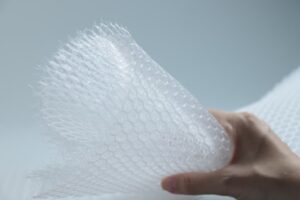
The fabric uses monofilament throughout its construction and has two different open mesh surfaces. One side has approximately 10 × 5 mm hexagonal openings, while the other has approximately 13 × 6 mm openings.
The resulting construction is intentionally:
- lightweight
- soft and elastic
- highly open
- quick drying
- suitable where thickness is required without excessive material weight
T2D-2N6P demonstrates an important principle:
A thick spacer fabric does not necessarily need to be a heavy spacer fabric.
For applications where low product weight and an open structure are priorities, a relatively low-GSM but thick construction may actually be preferable.
Does Higher GSM Mean Stronger 3D Spacer Mesh?
Not necessarily.
Higher GSM means more material exists per square meter, but it should not automatically be interpreted as higher compression resistance or better support.
Support in 3D spacer mesh is influenced by several factors:
- Spacer monofilament diameter
- Spacer monofilament density
- Monofilament arrangement
- Face yarn specification
- Back construction
- Mesh opening size and geometry
- Fabric thickness
- Overall knitting structure
Mefiss T2S-2A is a useful example of a heavy, high-support construction.
T2S-2A is approximately 20.1 mm thick and 1,350 GSM. It uses 900D face and back yarns together with a 26S spacer monofilament.
Its spacer layer uses relatively coarse, high-density monofilaments. The fabric is designed to provide strong recovery and load-bearing support, while the coarse face yarns contribute to a firm and robust overall construction.
In T2S-2A, high GSM exists together with high support—but the support comes from the complete structure, not from the GSM number alone.
Lower GSM Does Not Mean Lower Quality
This is another common misunderstanding.
A lightweight spacer mesh may be intentionally engineered for softness, flexibility, ventilation, or lower finished-product weight.
For example, Mefiss T2S-4L at approximately 10.6 mm and 450 GSM uses relatively fine spacer monofilaments. The construction is softer than many conventional firm 3D meshes and has open mesh surfaces on both sides.
T2S-4L can be useful for applications such as:
- breathable pillow components
- mattress quilting layers
- soft ventilation layers
- cushioning components where excessive firmness is undesirable
Therefore:
Low GSM should be understood as a construction characteristic, not a quality grade.
The question is not whether a higher or lower GSM is “better.” The question is whether the construction matches the product requirement.
Does High GSM Reduce Airflow?
Not automatically.
Airflow through 3D spacer mesh depends heavily on the geometry of the fabric.
Important factors include:
- Mesh hole size
- Hole shape
- Whether openings align through both surfaces
- Face and back openness
- Spacer yarn arrangement
- Internal air-channel structure
For example, Mefiss T2S-2A is a heavy construction at approximately 1,350 GSM, but both sides use large open mesh holes of approximately 8 × 5 mm.
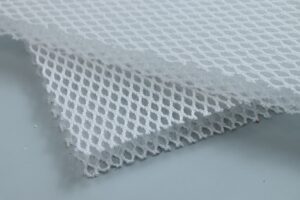
The T2S-2A structure therefore still provides open passages through the fabric despite its high material weight.
This is why GSM alone should not be used to estimate air permeability.
When airflow is critical, buyers should evaluate the actual mesh construction and, when necessary, request air-permeability test data for the specific fabric.
The Same or Similar GSM Can Represent Very Different Fabrics
Suppose two fabrics are both offered at around 600 GSM.
That does not mean the two materials are equivalent.
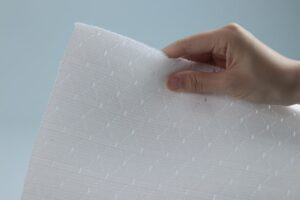
For example, Mefiss T2D-4P has a specification at approximately 620 GSM and 5.9 mm thickness, with a 300D face yarn, 16S spacer monofilament and double-back construction. Other 3D spacer mesh constructions around a similar weight can use different thicknesses, mesh geometries and internal yarn arrangements.
They may differ in:
- thickness
- yarn size
- spacer monofilament
- surface texture
- mesh opening
- face and back construction
- stretch
- firmness
- compression recovery
- usable width
Even fabrics with very similar appearances may have different internal constructions.
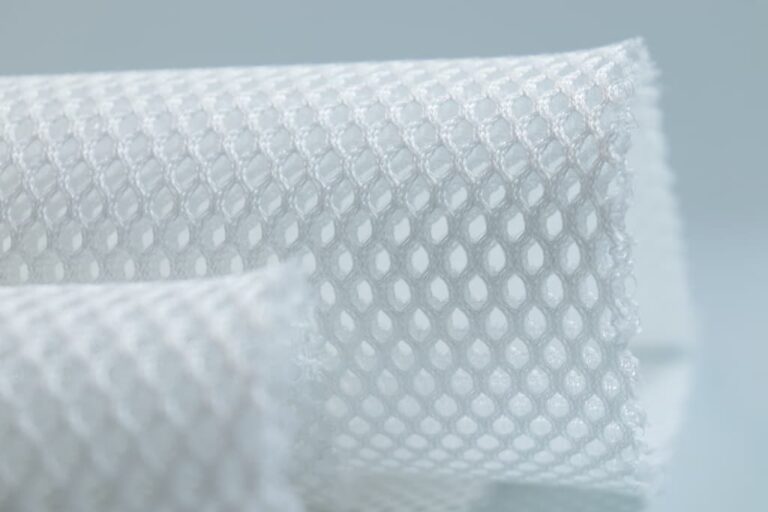
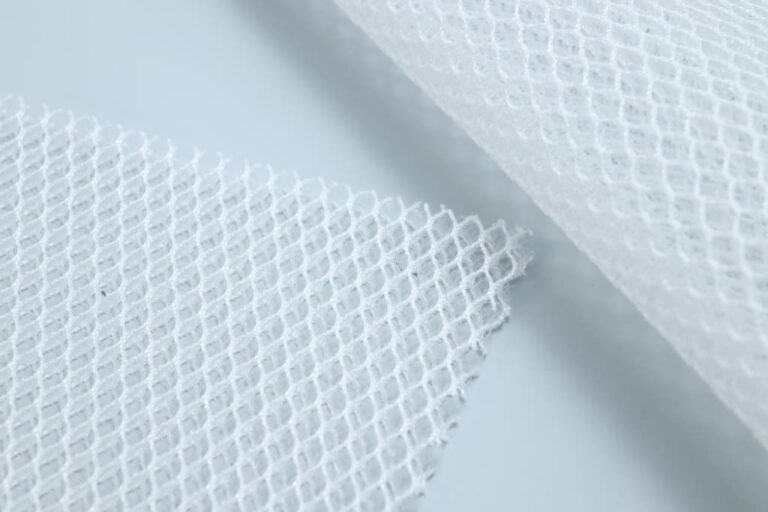
This is particularly important when sourcing by photographs. A product image can show the surface pattern and color, but it cannot reliably tell you the fabric’s GSM, spacer density, firmness, or compression behavior.
For development projects, physical samples and confirmed specifications are therefore much more useful than appearance alone.
A Simple Way to Understand GSM Relative to Thickness
For illustration, we can divide GSM by thickness:
GSM ÷ Thickness
Using several actual Mefiss product specifications:
Mefiss Product Code GSM Thickness GSM ÷ Thickness
T2D-2N6P 310 14.3 mm ≈22 T2D-1R 830 10.3 mm ≈81 T2S-2A 1,350 20.1 mm ≈67
This comparison shows how differently material can be distributed within a spacer structure.
Mefiss T2D-2N6P, at 14.3 mm, uses much less material relative to its thickness than Mefiss T2D-1R, at 10.3 mm.
Important: GSM ÷ thickness is not a standardized textile performance metric, and it should not be used as a substitute for compression, airflow, density, or other laboratory testing.
It is simply a useful way to visualize why GSM and thickness need to be considered together.
Common Mistake: Buying 3D Spacer Mesh by GSM Alone
A buyer may send an inquiry such as:
“We need 600 GSM 3D spacer mesh.”
For us as a manufacturer, this is useful information—but it is not enough to identify the right fabric.
For example, even knowing that Mefiss T2D-4P has a specification around 620 GSM does not mean it is automatically suitable for every buyer asking for approximately 600 GSM.
We would still need to know:
- What thickness do you need?
- What is the final application?
- Do you need soft, medium, or firm support?
- How open should the mesh structure be?
- Does the fabric directly contact the skin?
- What usable width is required?
- Is airflow, cushioning, support, or low weight the main priority?
A more useful specification might look like this:
Thickness: 8–10 mm
Target weight: approximately 500–700 GSM
Application: mattress ventilation layer
Structure: open mesh with good airflow
Support: medium
Width: minimum 210 cm
With this information, we can match the requirement against existing fabrics much more accurately.
How Should Buyers Choose the Right GSM?
Instead of beginning with GSM alone, we recommend starting with the application.
Step 1: Define the Application
Tell the supplier what the fabric will actually be used for.
Examples include:
- mattress ventilation layer
- mattress side panel
- seat cushion
- automotive seat
- pillow component
- medical product
- protective padding
- outdoor cushion
- breathable apparel
- bag or backpack padding
The application immediately helps narrow the possible constructions.
Step 2: Determine the Required Thickness
Thickness strongly affects the three-dimensional function of spacer mesh.
A thin spacer fabric used in apparel performs a very different role from a 10–20 mm fabric used as a cushioning or support component.
For example, Mefiss T2D-4P (5.9 mm / 620 GSM), T2D-1R (10.3 mm / 830 GSM) and T2S-2A (20.1 mm / 1,350 GSM) represent very different thickness and construction levels even though all belong to the broader 3D mesh category.
Step 3: Define the Required Support
Do you need:
- soft and flexible
- medium support
- firm and load-bearing
This information can be more useful than GSM alone because it helps us evaluate the spacer monofilament and overall construction.
For example, Mefiss T2S-4L (10.6 mm / 450 GSM) uses a finer spacer monofilament for a softer construction, while Mefiss T2S-2A (20.1 mm / 1,350 GSM) uses a much heavier and more supportive construction.
Step 4: Define the Airflow Structure
If ventilation is important, specify whether you require:
- open mesh on both sides
- aligned or through-hole openings
- highly open airflow channels
- a smoother skin-contacting surface
- a more stable or closed back surface
For example, Mefiss T2D-2N6P uses two open mesh surfaces and a lightweight monofilament construction, while Mefiss T2S-2A uses large approximately 8 × 5 mm openings together with a much heavier support structure.
Step 5: Use GSM to Refine the Selection
Once application, thickness, structure, and support are understood, GSM becomes much more useful.
At this stage it can help balance:
- finished-product weight
- material usage
- structural density
- handling
- cost
- shipping weight
This is a much more reliable way to select 3D spacer mesh.
GSM Is a Specification, Not a Performance Test
Another important distinction for buyers is that GSM is easy to measure, but it does not replace performance testing.
For technical applications, additional evaluation may include:
- air permeability
- compression resistance
- compression recovery
- tensile or tear performance
- dimensional stability
- wash durability
- abrasion resistance
- flammability, when required by the application or market
Two fabrics with the same GSM may produce very different results in these tests.
For this reason, technical projects should be evaluated using the parameters that actually matter to the finished product.
What Information Should You Send to a Spacer Mesh Manufacturer?
If you are developing a new product, providing the following information can significantly speed up material matching:
Information Example
Application Mattress ventilation layer Thickness 8–10 mm Target GSM 500–700 GSM Width ≥210 cm Support Medium Surface Comfortable for indirect skin contact Airflow Open structure preferred Stretch Low / Medium / High Washability Required Color White / Black / Custom Required tests Air permeability, compression recovery, etc. Estimated quantity kg / meters / annual demand
If some specifications are unknown, the application itself is often the best place to start.
A manufacturer can then recommend suitable existing constructions for sampling and testing.
Final Takeaway: Don’t Choose 3D Spacer Mesh by GSM Alone
There is no single “best GSM” for 3D spacer mesh fabric.
A 300 GSM fabric is not automatically too light, and a 1,000+ GSM fabric is not automatically better or more supportive.
Our own product range illustrates this clearly:
- Mefiss T2D-2N6P — 14.3 mm / 310 GSM: a thick but lightweight monofilament construction
- Mefiss T2S-4L — 10.6 mm / 450 GSM: a softer construction using relatively fine spacer monofilament
- Mefiss T2D-1R — 10.3 mm / 830 GSM: a denser double-back construction with 18S spacer monofilament
- Mefiss T2S-2A — 20.1 mm / 1,350 GSM: a thick, firm construction using coarse, high-density spacer monofilament
The correct specification depends on how several variables work together:
Application → Thickness → Support → Structure → GSM
For buyers, GSM should therefore be treated as one part of the specification rather than the final selection criterion.
Understanding this relationship makes it much easier to select a spacer mesh that performs correctly in the finished product.
Need Help Matching a 3D Spacer Mesh Specification?
Mefiss Textile manufactures a wide range of 3D spacer mesh and spacer mesh fabrics with different thicknesses, weights, mesh structures, widths, yarn constructions, and support levels.
If you are developing a mattress, cushion, seating, medical, apparel, automotive, or other technical product, send us your application, target thickness, approximate GSM, required width, support level, and performance requirements.
We can compare these requirements with our existing fabric range and recommend suitable materials for sampling and further testing.
When browsing our Mesh Gallery, you can also use the Mefiss product codes referenced in this guide—such as T2D-4P, T2D-1R, T2D-2N6P, T2S-4L and T2S-2A—to locate the corresponding fabric specifications and product pages.
Leave a Reply