Single Bottom vs. Double Bottom Spacer Mesh: How Should Buyers Choose?
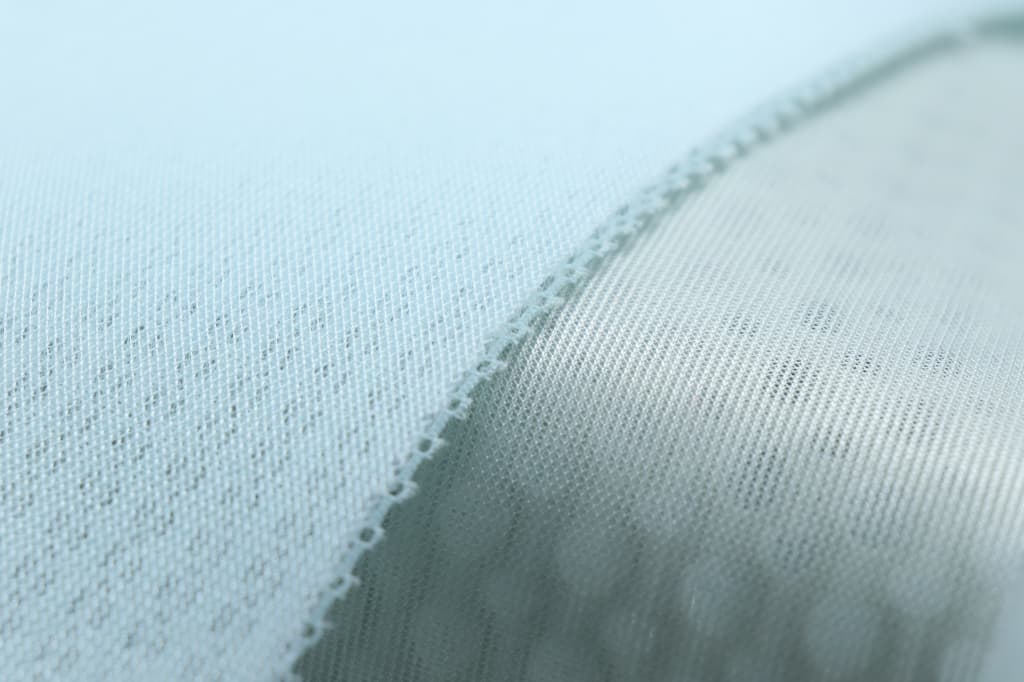
A Practical Guide to Choosing the Right Backing Structure for Your Spacer Mesh Application
When sourcing spacer mesh fabric, buyers often encounter two terms in specifications: single bottom and double bottom.
At first glance, the distinction appears simple. Single-bottom spacer mesh has a more open backing construction, while double-bottom spacer mesh generally has a denser backing. This can lead to an easy assumption: single bottom is for breathability, while double bottom is the stronger or “better” version.
In practice, fabric selection is more complicated.
The bottom structure can influence weight, openness, stretch, dimensional stability, and processing behavior, but it is only one part of the complete spacer mesh construction. Face structure, mesh opening, yarn specification, spacer yarn density, thickness, GSM, and finishing can all change how the final fabric performs.
For buyers, the more useful question is therefore not:
“Is single bottom or double bottom better?”
It is:
“Which backing structure provides the right balance of airflow, weight, stretch, stability, and processing performance for my product?”
This guide explains how to make that decision.
What Is the “Bottom” in Spacer Mesh Fabric?
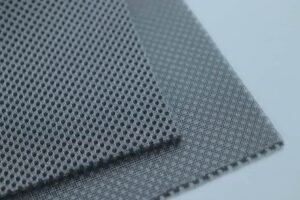
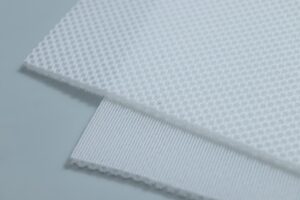
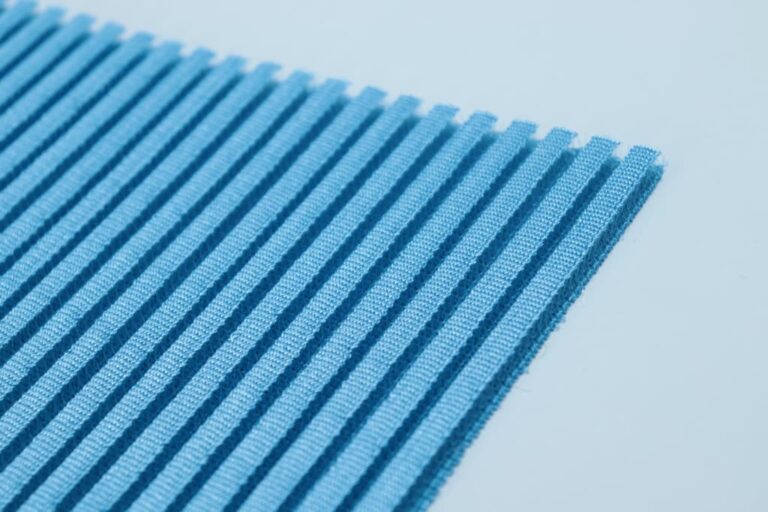
Spacer mesh is a three-dimensional textile structure consisting of two outer fabric layers connected and separated by spacer yarns. The two outer layers can use different structures, while the connecting yarns create the three-dimensional space between them. This basic construction is also described in textile engineering literature on warp-knitted spacer fabric structures.
In simplified form, spacer mesh consists of three parts:
- Face layer – the visible surface, which may contain round, diamond, oval, honeycomb, or other mesh openings.
- Spacer layer – connecting yarns that separate the two surfaces and create thickness.
- Bottom layer – the backing structure on the reverse side of the fabric.
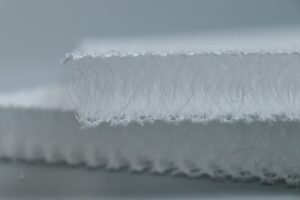
The bottom layer can be knitted in different ways.
Two common constructions are:
- Single bottom
- Double bottom
The difference is not simply cosmetic. Changing the backing construction changes the amount and arrangement of yarn on the reverse side and can affect how the whole fabric behaves.
However, buyers should remember one important principle:
Single bottom and double bottom describe fabric construction. They are not quality grades.
A well-designed single-bottom fabric is not an inferior version of a double-bottom fabric, and a double-bottom fabric is not automatically higher quality.
What Is Single-Bottom Spacer Mesh?
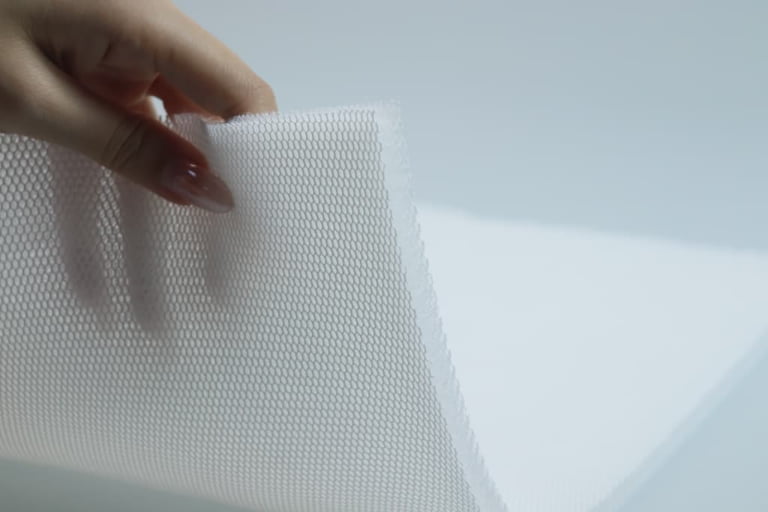
A single-bottom spacer mesh uses a relatively open backing construction.
In many designs, this creates a visibly more open reverse surface and reduces the amount of material used in the backing.
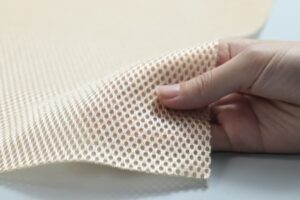
One example from Mefiss is our AC1 spacer mesh fabric.
One lightweight AC1 specification is:
| Specification | AC1 |
|---|---|
| Width | 220 cm |
| Weight | 130 gsm |
| Thickness | 1.0 mm |
| Composition | 100% polyester |
| Spacer yarn | 30D |
| Bottom structure | Single bottom |
This particular AC1 construction has a relatively sparse backing and is designed as a lightweight, breathable spacer mesh. It also shows substantial stretch in the weft direction.
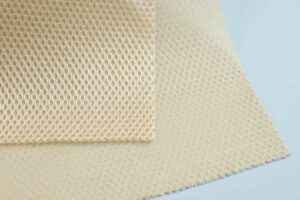
Another example is AD2-1A, a 200 gsm, 3.1 mm spacer mesh with a single-bottom construction. Its face uses very small diamond-shaped openings, while the reverse side is relatively open. This fabric also has noticeable stretch in both directions.
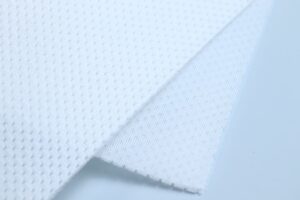
These examples illustrate several characteristics that can occur with single-bottom constructions:
- More open backing
- Lower material usage
- Potential for lower fabric weight
- Greater flexibility
- Greater stretch in some constructions
- Good potential for ventilation
But these should be treated as design tendencies rather than universal rules.
A single-bottom fabric can still be heavy, thick, firm, or relatively stable if its yarn specifications and knitting construction are changed.
What Is Double-Bottom Spacer Mesh?
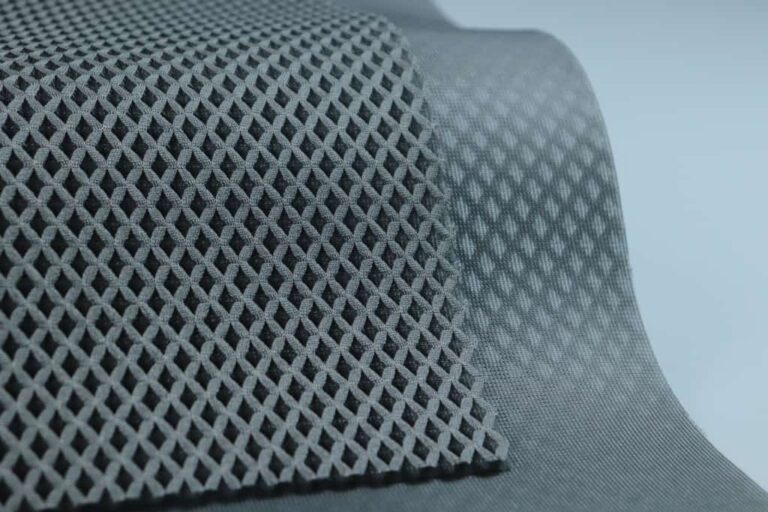
Double-bottom spacer mesh uses a denser backing construction.
The additional backing structure can make the reverse side look tighter and can contribute to greater dimensional stability.
For example, Mefiss BC2D-2A has the following specification:
| Specification | BC2D-2A |
|---|---|
| Width | 220 cm |
| Weight | 240 gsm |
| Thickness | 3.4 mm |
| Composition | 100% polyester |
| Face yarn | 300D/144F |
| Spacer yarn | 30D |
| Bottom yarn | 250D/72F |
| Bottom structure | Double bottom |
Its backing is relatively dense, and the fabric has good dimensional stability with moderate stretch.
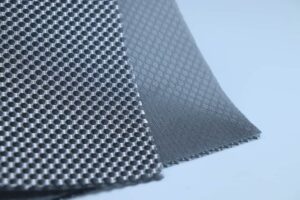
Another Mefiss double-bottom fabric, BD2-4B4, uses a dense backing that creates a tighter overall construction and considerably reduces stretch compared with many conventional spacer mesh structures.
This type of construction can be useful when buyers are particularly concerned about:
- Dimensional stability
- Controlled stretch
- A tighter backing surface
- Fabric handling during downstream processing
- Structural consistency in the finished product
Again, this does not mean every double-bottom fabric behaves the same way.
Single Bottom vs. Double Bottom: Key Differences
A useful starting point for buyers is the following comparison.
| Factor | Single Bottom | Double Bottom |
|---|---|---|
| Backing structure | Generally more open | Generally denser |
| Potential weight | Can be lighter | Can be heavier |
| Stretch | Often greater in some constructions | Often more controlled |
| Dimensional stability | Depends strongly on construction | Dense structures can improve stability |
| Backing openness | Usually higher | Usually lower |
| Airflow potential | Can benefit from open backing | Depends on complete mesh construction |
| Flexibility | Often relatively flexible | Can feel more structured |
| Processing | Depends on application | Dense backing may help where stability is important |
The words “can,” “often,” and “generally” are important.
Spacer mesh is an engineered textile. Changing only one variable does not determine the complete performance of the fabric.
Research on three-dimensional spacer fabrics supports this broader view. Experimental studies have found that tensile, bending, compression, air permeability, and other properties can be influenced by variables including spacer yarn type, yarn count, stitch density, spacer yarn configuration, and overall fabric density. This is why spacer fabric selection should be based on the complete construction and intended application, rather than one structural feature alone.
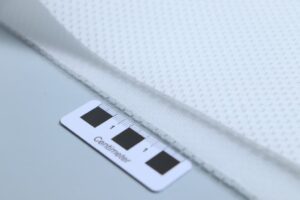
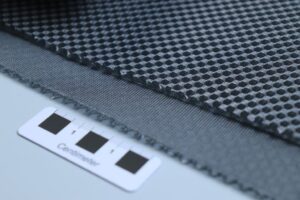
Does Single Bottom Mean Better Breathability?
Not necessarily.
This is one of the most important points for buyers to understand.
A sparse single-bottom construction can provide a more open path on the reverse side of the fabric. This can certainly be beneficial when ventilation is important.
But airflow must pass through the entire fabric structure, not only the bottom.
Actual breathability can also be affected by:
- Size of the face openings
- Percentage of open area
- Backing openness
- Yarn thickness
- Knitting density
- Spacer yarn density
- Fabric thickness
- Alignment of openings through the fabric
The importance of considering the complete structure is also reflected in textile testing standards. ASTM D737 notes that fabric construction factors and finishing techniques can have an appreciable effect on air permeability.
A good example is Mefiss BC2-6A.
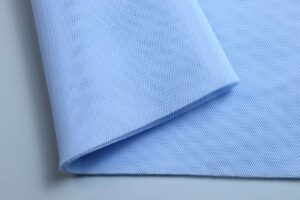
BC2-6A uses a double-bottom construction, but both surfaces contain approximately 2 mm × 1 mm honeycomb openings. The openings pass through the structure, giving the fabric strong ventilation compared with many conventional spacer mesh constructions.
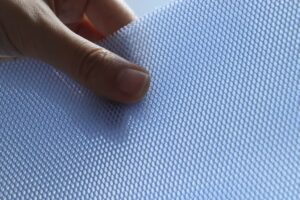
So a buyer should not automatically conclude:
Single bottom = breathable
Double bottom = not breathable
That is too simplistic.
If airflow is an important technical requirement, ask the supplier about the complete fabric construction and request comparable air-permeability test data when necessary.
ISO 9237 provides an international test method for determining the permeability of fabrics to air and is applicable to most fabric types, including industrial fabrics for technical purposes.
For buyers comparing several spacer mesh options, measured air-permeability data can therefore be more useful than judging airflow only from photographs or the terms “single bottom” and “double bottom.”
Does Double Bottom Mean Higher GSM?
A double-bottom construction can add material to the backing, but buyers should not use bottom structure alone to predict GSM.
Fabric weight is affected by many variables, including:
- Face yarn specification
- Bottom yarn specification
- Spacer yarn specification
- Yarn density
- Mesh opening
- Knitting structure
- Fabric thickness
- Finishing conditions
Consider two Mefiss fabrics.
AD2-1A — Single Bottom
- 220 cm width
- 200 gsm
- 3.1 mm thickness
- 68D/36F face yarn
- 30D spacer yarn
- 75D/48F bottom yarn
BC2D-2A — Double Bottom
- 220 cm width
- 240 gsm
- 3.4 mm thickness
- 300D/144F face yarn
- 30D spacer yarn
- 250D/72F bottom yarn
BC2D-2A is 40 gsm heavier, but it would be incorrect to say that the double-bottom structure caused the entire 40 gsm difference.
The two fabrics use different face yarns, bottom yarns, mesh designs, and overall constructions.
For a meaningful comparison, buyers should compare fabrics with similar:
- Yarn specifications
- Thickness
- Face construction
- Knitting density
- Finishing conditions
This is particularly important when comparing samples from different suppliers.
Stretch May Matter More Than the Structure Name
For many applications, the practical question is not whether a fabric is labeled single or double bottom.
It is:
How much does the fabric stretch in the warp and weft directions?
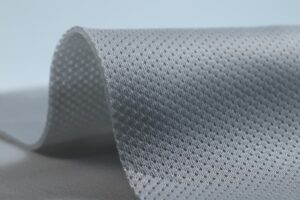
For example, Mefiss AD2-1A uses a relatively sparse single-bottom construction and has considerable stretch.
By comparison, several of our dense double-bottom constructions show much lower stretch and better dimensional stability.
This difference can become important when spacer mesh will later be:
- Cut into precise shapes
- Sewn into covers or panels
- Laminated with another material
- Quilted
- Tensioned over another structure
- Assembled into a finished product
Therefore, a professional specification should not stop at:
Bottom structure: Double bottom
It should also describe or test the actual directional stretch of the fabric when this characteristic matters to the finished product.
Why Buyers Should Examine Both Sides of the Fabric
When selecting mesh online, buyers often receive only a photograph of the front surface.
That is not enough for spacer mesh.
Two fabrics can have very similar face patterns but completely different backing structures.
When evaluating a new spacer mesh, we recommend checking at least:
- Front surface
- Back surface
- Side profile
- Thickness
- GSM
- Bottom structure
- Face yarn
- Spacer yarn
- Bottom yarn
- Warp-direction stretch
- Weft-direction stretch
For technical applications, additional information such as air permeability, compression behavior, abrasion resistance, washability, or flammability may also be necessary.
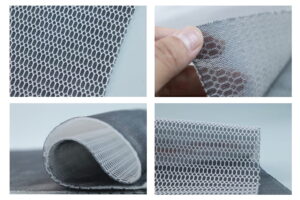
This gives the buyer a much more accurate understanding of the material than a face photograph alone.
Mefiss Insight: Bottom Structure Is Only One Variable
After working with many different spacer mesh constructions, one of the most common sourcing mistakes we see is trying to specify a fabric with one isolated parameter.
For example:
“We need 3 mm double-bottom spacer mesh.”
This sounds specific, but it still leaves many unanswered questions.
What GSM is required?
How large should the openings be?
Should the fabric stretch?
How stable should it be after cutting?
Does the surface touch the skin?
Is high airflow important?
Will the material be sewn, quilted, laminated, or tensioned?
A 3 mm double-bottom spacer mesh can be engineered in many different ways depending on these requirements.
At Mefiss, our spacer mesh specifications therefore consider multiple parameters together, including thickness, GSM, width, mesh structure, yarn specification, stretch, surface feel, airflow requirements, finishing, and intended application.
The backing structure should be selected as part of the complete fabric design—not as an isolated specification.
How Should Buyers Choose?
Instead of starting with “single bottom or double bottom?”, start with the performance required from the final material.
| Buyer Requirement | What to Evaluate |
|---|---|
| Lightweight construction | GSM, yarn specification and backing density |
| High ventilation | Face openings, backing openness and actual airflow |
| Greater flexibility | Overall construction and directional stretch |
| Dimensional stability | Warp/weft stretch and backing construction |
| Strong support | Spacer yarn density, thickness and complete structure |
| Sewing | Stretch, edge behavior and dimensional stability |
| Lamination | Backing surface and processing requirements |
| Direct skin contact | Face yarn, surface texture and finishing |
| Technical performance | Relevant test data rather than visual judgment |
For example, if a buyer needs a lightweight, flexible material with an open reverse surface, a single-bottom construction may be a logical direction to evaluate.
If the application requires a tighter backing and controlled dimensional behavior, a dense double-bottom construction may be worth considering.
But the final decision should always be based on the complete specification and actual sample performance.
What Information Should You Send to a Spacer Mesh Supplier?
For faster material matching, provide more than just thickness and color.
A useful sourcing request should include:
- Application – What product will the fabric be used in?
- Target thickness – For example, 2 mm, 3 mm, or 5 mm.
- Target GSM – If already known.
- Required width – Especially important for large panels.
- Airflow requirement – Is ventilation a primary function?
- Stretch requirement – Should the fabric stretch or remain stable?
- Support/recovery requirement – Is cushioning or structural support important?
- Surface requirement – Soft, smooth, abrasion-resistant, or non-skin-contact?
- Processing method – Sewing, quilting, lamination, cutting, etc.
- Bottom preference – Single or double bottom, if already specified by your design.
If some of these parameters are unknown, the intended application is often the best starting point.
A mesh manufacturer can then recommend suitable constructions for sampling and evaluation.
Real Mefiss Spacer Mesh Examples
The following fabrics demonstrate why buyers should compare actual constructions rather than relying only on the terms “single bottom” and “double bottom.”
AC1 — Lightweight Single-Bottom Spacer Mesh
A classic spacer mesh structure available in multiple specifications. One lightweight version is 130 gsm with a sparse single-bottom backing, providing a lightweight and open construction.
Useful for understanding: lightweight construction, openness, stretch, and conventional spacer mesh design.
AD2-1A — Fine-Hole Single-Bottom Spacer Mesh
A 3.1 mm, 200 gsm fabric with approximately 1.5 × 1.5 mm diamond-shaped face openings and an open single-bottom backing.
Useful for understanding: how face-hole design and backing construction can be combined independently.
BC2D-2A — Stable Double-Bottom Spacer Mesh
A 3.4 mm, 240 gsm construction using a dense double bottom and relatively heavy face and bottom yarns.
Useful for understanding: tighter backing structures and dimensional stability.
BC2-6A — Breathable Double-Bottom Spacer Mesh
A double-bottom construction with small honeycomb openings passing through both surfaces.
Useful for understanding: why double bottom should not automatically be interpreted as low breathability.
Frequently Asked Questions
Is double-bottom spacer mesh better than single-bottom spacer mesh?
No. They are different constructions rather than quality grades. The correct choice depends on the required weight, openness, stretch, stability, airflow, processing method, and final application.
Is single-bottom spacer mesh always lighter?
Not always. An open backing can help reduce material usage, but GSM also depends on yarn specifications, knitting density, thickness, mesh structure, and other construction variables.
Is single-bottom spacer mesh always more breathable?
No. Backing openness is only one factor affecting airflow. Face openings, yarn density, spacer construction, thickness, and through-hole alignment also influence breathability. Some double-bottom structures can still provide excellent airflow.
Is double-bottom spacer mesh more dimensionally stable?
A dense double-bottom construction can contribute to better dimensional stability and controlled stretch, but buyers should verify the actual fabric because yarns and knitting structures also influence stretch.
What should I request before ordering spacer mesh?
At minimum, confirm thickness, GSM, width, composition, mesh structure, bottom structure, yarn specifications, stretch behavior, color, and intended application. For technical applications, request relevant performance test data when necessary.
Final Takeaway
The difference between single-bottom and double-bottom spacer mesh is important, but it should never be the only factor used to select a fabric.
A single-bottom structure may provide a more open, lightweight, and flexible construction. A dense double-bottom structure may offer a tighter backing and more controlled dimensional behavior.
Neither is inherently better.
For professional buyers, the best approach is to define the performance requirements of the finished product first and then evaluate the complete spacer mesh specification.
Look beyond the label.
Compare the face structure, backing, yarn specifications, thickness, GSM, stretch, airflow, and processing requirements together.
That is how you choose spacer mesh based on what the material actually needs to do—not simply whether the specification says “single bottom” or “double bottom.”
Need Help Selecting the Right Spacer Mesh?
Send Mefiss your target application, thickness, GSM, width, stretch, airflow, surface, and processing requirements. We can recommend suitable spacer mesh constructions for sampling and evaluation.
View Spacer Mesh Fabrics → Mesh Gallery
Discuss Your Requirements → Contact Mefiss
Previous
3D Spacer Mesh Weight & GSM Guide: How to Choose the Right Fabric
Next
What Does GSM Mean in Spacer Mesh Fabric, and Does Higher GSM Mean Better Quality?
Leave a Reply