
What Does GSM Mean in Spacer Mesh Fabric, and Does Higher GSM Mean Better Quality?
When sourcing spacer mesh fabric, GSM is one of the first numbers buyers usually see on a specification sheet.
You may receive options such as:
- 130 GSM
- 200 GSM
- 300 GSM
- 500 GSM
This often leads to a simple assumption:
“A higher GSM fabric contains more material, so it must be stronger and better.”
That assumption can be misleading.
GSM is an important specification, but it does not represent the overall quality of a spacer mesh fabric. Two fabrics with similar GSM can have very different thickness, mesh openings, yarn specifications, stretch, support, airflow, surface feel, and end-use performance.
For professional buyers, the better question is:
“What does this GSM tell me about the fabric, and what does it not tell me?”
This guide explains how to use GSM correctly when comparing and specifying spacer mesh fabric.
What Does GSM Mean in Fabric?
GSM stands for grams per square meter.
It describes how much one square meter of fabric weighs.
For example:
- 130 GSM = one square meter weighs approximately 130 grams
- 200 GSM = one square meter weighs approximately 200 grams
- 300 GSM = one square meter weighs approximately 300 grams
So GSM is fundamentally a measurement of fabric weight per unit area.
In standardized textile testing, fabric weight is formally treated as mass per unit area. ASTM D3776/D3776M covers the measurement of fabric mass per unit area and is applicable to most fabrics.
It is not a direct measurement of:
- Thickness
- Strength
- Breathability
- Support
- Compression recovery
- Softness
- Durability
- Quality
These properties may sometimes correlate with GSM, but they are not interchangeable.
This distinction is especially important for spacer mesh because it is a three-dimensional knitted structure, rather than a simple flat fabric. Spacer fabrics consist of two outer textile layers connected by spacer yarns, and their physical and mechanical behavior depends on multiple structural variables. A study of the physical and mechanical properties of three-dimensional spacer fabrics illustrates how construction variables influence different aspects of fabric performance.

How Is Spacer Mesh GSM Measured?
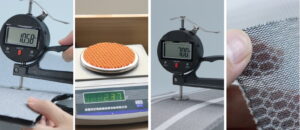
There are two practical ways we use to evaluate fabric weight.
Method 1: Small Sample Measurement
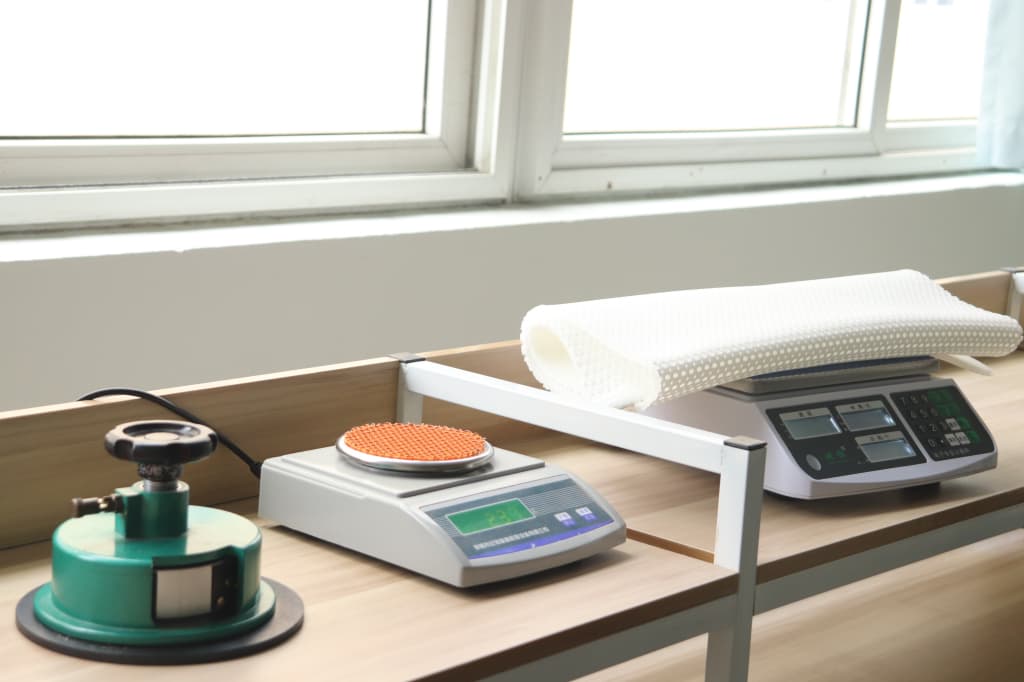
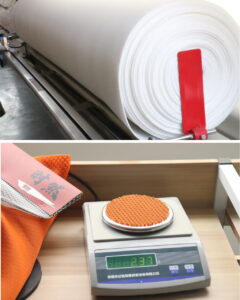
A circular GSM cutter can be used to cut a defined area from the fabric. The specimen is then weighed on an electronic scale and converted into grams per square meter.
This method is convenient for:
- Sample inspection
- Quick production checks
- Comparing different positions across the fabric
- Incoming or outgoing quality control
However, a small specimen represents only a very small area of the complete roll.
This limitation is also reflected in standardized fabric-weight testing. ASTM D3776/D3776M distinguishes between measurements based on a full piece, a full-width sample, a small swatch, and narrow fabrics. Results from a small swatch apply to that sample and may not necessarily represent the entire lot.
This matters with spacer mesh.
During finishing, the edges and center of the fabric can experience slightly different tension. Therefore, measurements taken from the left, center, and right positions may not always be identical.
At Mefiss, when local GSM measurements are required, checking different positions across the width gives a more representative picture than relying on one small sample alone.
Method 2: Average Bulk GSM
For production orders, another useful method is to calculate:
Total fabric weight ÷ total fabric area
For example, if a production batch contains 10,000 m² of fabric and has a net fabric weight of 2,000 kg:
2,000,000 g ÷ 10,000 m² = 200 GSM
For thick 3D mesh, Mefiss generally considers this average method particularly useful because a small cut specimen can produce a larger measurement error when the material is thick and heavy.
What Is a Typical GSM for Spacer Mesh Fabric?
There is no single “correct” GSM for spacer mesh.
The appropriate weight depends on the fabric structure and intended application.
Within the Mefiss product range, spacer mesh fabrics are commonly around 100–600 GSM, while thicker 3D mesh constructions can range approximately 300–1500 GSM.
This wide range exists because spacer fabrics can be engineered for very different functions.
A lightweight fabric may be developed for applications where flexibility and lower material weight are important.
A heavier structure may use more or thicker yarns to provide greater body, support, abrasion resistance, or compression performance.
But these are general tendencies.
GSM should always be evaluated together with the complete construction.
Does Higher GSM Mean Better Quality?
No.
Higher GSM means there is more fabric mass per unit area.
It does not automatically mean the fabric has higher quality.
Consider a buyer looking for a breathable spacer mesh for a lightweight product.
A 400 GSM construction might contain more material than a 200 GSM construction, but the additional weight could be completely unnecessary for the application.
It may even create disadvantages such as:
- Higher finished-product weight
- Higher material consumption
- Higher shipping weight
- Less flexibility
- Unnecessary cost
On the other hand, if the product needs more body, structural support, abrasion resistance, or compression performance, a heavier construction may be more appropriate.
Academic research on spacer fabrics supports this broader approach. Physical and mechanical properties such as tensile behavior, bending, compression and air permeability are affected by variables including spacer yarn type, yarn count, stitch density, spacer yarn configuration and fabric density. The appropriate spacer construction should therefore be selected according to the intended application rather than one specification alone.
The correct question is therefore not:
“Which fabric has the highest GSM?”
It is:
“Which GSM and construction provide the performance my product actually needs?”
Why Two Fabrics with Similar GSM Can Perform Differently
This is one of the most important points for buyers.
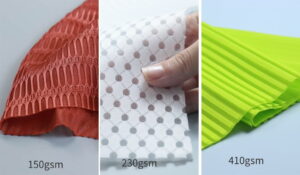
Imagine two spacer mesh fabrics that are both approximately 250 GSM.
They may still have completely different:
- Yarn sizes
- Mesh-hole shapes
- Open-area percentages
- Face structures
- Bottom structures
- Spacer yarn densities
- Thicknesses
- Stretch characteristics
- Surface textures
One could be relatively thin and dense.
Another could be thicker and more open.
One could stretch significantly.
Another could be dimensionally stable.
One could have a soft surface suitable for closer body contact.
Another could use a rougher, more abrasion-resistant structure.
Therefore:
Similar GSM does not mean similar fabric.
For spacer mesh sourcing, GSM is a useful filtering parameter, but it is not enough to approve a material.
Does Higher GSM Mean Thicker Spacer Mesh?
Not necessarily.
GSM and thickness are related to different physical characteristics.
GSM measures:
Mass per unit area
Thickness measures:
The distance between the two outer surfaces of the fabric
These are separate physical properties in textile testing. For example, ISO 5084 covers the determination of the thickness of textiles and textile products.
A fabric manufacturer can change GSM without changing thickness proportionally.
For example, a fabric may become heavier because it uses:
- Thicker face yarn
- Thicker bottom yarn
- More densely knitted surfaces
- More spacer yarns
- A denser mesh structure
Another fabric may achieve greater thickness through a taller spacer structure without using proportionally more yarn.
This is why buyers should specify GSM and thickness separately.
Within our normal production range, Mefiss spacer mesh is generally around 1–8 mm, while thicker 3D mesh structures are commonly around 5–20 mm. (For a more detailed explanation, read our guide: [How to Choose the Right Thickness for Spacer Mesh and 3D Mesh Fabric].)
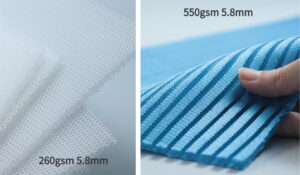
Yarn Specification Has a Major Effect on GSM
Spacer mesh is not a single-layer material.
Its total weight comes from multiple yarn systems, including:
Face yarn + spacer yarn + bottom yarn
Changing any of these can change the GSM.
For example, compare using a finer multifilament yarn with using a heavier yarn in the face layer.
Even if the overall fabric thickness remains similar, the heavier yarn can increase fabric mass considerably.
The same applies to the bottom layer.
A dense double-bottom construction using heavier yarns can add substantially more mass than a sparse single-bottom construction.
The spacer yarn itself also matters.
When a thicker spacer mesh needs stronger elasticity or support, the manufacturer may increase the density or size of the spacer yarn.
Research into the compression behavior of 3D spacer fabric structures also shows why the spacer yarn cannot be ignored: spacer monofilament architecture, diameter, inclination angle and fabric thickness can materially influence compression resistance.
That can increase GSM as well.
So when comparing two fabrics, do not look only at:
250 GSM vs. 300 GSM
Also look at:
What yarns and structures are creating that weight?
Mesh Structure Also Changes GSM
Imagine two fabrics made with similar yarn specifications.
Fabric A has relatively large open mesh holes.
Fabric B has a dense surface with small openings.
The denser surface generally requires more yarn per unit area.
As a result, it may have a higher GSM even if the two fabrics have similar thickness.
Bottom construction can create the same effect.
As discussed in our guide to Single Bottom vs. Double Bottom Spacer Mesh, a dense backing can contain more yarn than a sparse backing.
But again, this is only one variable.
Face construction, yarn size, knitting density, spacer yarn and finishing conditions must all be considered together.
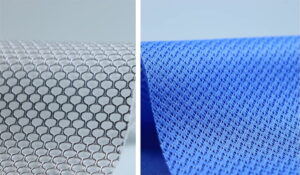
Fabric Width Can Affect the Final GSM
This is a more technical issue that buyers may overlook.
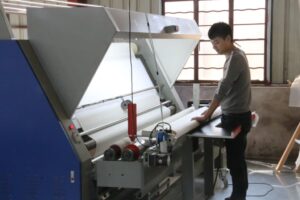
Spacer mesh passes through a heat-setting process after knitting. During this stage, width, overfeed, tension, speed, and temperature are controlled to stabilize the finished fabric.
If the same greige fabric is finished to different widths, the final structure can change.
For example, if a fabric normally finishes at 220 cm, setting it narrower can make the fabric structure denser and increase GSM.
Setting it wider can reduce GSM and alter the shape of the mesh openings.
Mefiss production experience also shows that width adjustment can affect not only GSM but also mesh shape, thickness, hand feel, and elasticity.
This means that a specification such as:
“200 GSM spacer mesh”
is still incomplete.
The finished width also matters.

Why Does GSM Have a Tolerance?
Buyers should not expect every centimeter of a production roll to have exactly the same mathematical GSM.
Textile manufacturing naturally involves tolerances.
Several factors can create small variations:
- Yarn variation
- Knitting conditions
- Fabric tension
- Heat-setting conditions
- Width adjustment
- Edge-to-center differences
- Beginning-to-stable finishing conditions
For example, the initial section of a heat-setting run may behave slightly differently while production parameters are stabilizing.
Order size can also influence how tightly some production parameters can be optimized because longer runs provide more stable production time.
As a practical production reference, Mefiss generally treats approximately ±5% as a normal GSM tolerance, while many of our production orders can be controlled within approximately 2–4%, depending on the fabric and production conditions.
For a nominal 200 GSM fabric:
±5% = approximately 190–210 GSM
This does not mean that buyers should ignore GSM variation.
Instead, buyer and supplier should agree on:
- Nominal GSM
- Acceptable tolerance
- Measurement method
- Sampling positions
- Whether approval is based on local readings or production average
before mass production when GSM is a critical parameter.

Does Higher GSM Mean Better Support and Recovery?
Sometimes there can be a relationship, but GSM alone cannot answer this question.
A heavier spacer mesh often contains more yarn, and heavier constructions can sometimes provide greater body or support.
But compression performance depends heavily on the spacer layer.
Important variables include:
- Spacer yarn size
- Spacer yarn density
- Spacer yarn angle
- Fabric thickness
- Knitting structure
- Surface construction
Research on the compression behavior of 3D spacer fabrics has found that spacer monofilament architecture plays an important role, with variables such as monofilament inclination angle, diameter and fabric thickness influencing compression resistance.
A fabric could therefore have a high GSM because it uses very heavy face yarns while still having a spacer structure that is not optimized for compression support.
If support and recovery are important to your product, ask for compression and recovery performance, not simply a higher GSM.
Does Higher GSM Mean Better Breathability?
Again, no.
A high-GSM spacer mesh can still be highly breathable if it uses large, aligned openings and an open three-dimensional structure.
A lighter fabric can also have relatively restricted airflow if its surface construction is dense.
Academic testing of spacer fabrics has found that air permeability is related to fabric density and overall spacer construction, while other mechanical properties are also influenced by yarn and structural variables.
For airflow-critical applications, evaluate:
- Mesh-hole size
- Open area
- Front and back structures
- Through-hole alignment
- Thickness
- Spacer density
- Air permeability test results
GSM should be part of the specification, but it should not replace actual airflow evaluation.
Does Higher GSM Mean Better Durability?
Not automatically.
More material can contribute to a more substantial construction, but durability also depends on:
- Yarn material
- Yarn denier
- Filament construction
- Knitting structure
- Abrasion resistance
- Stretch and recovery
- Finishing
- Actual end-use conditions
If abrasion resistance is important—for example, in seating, bags, footwear, automotive, or technical applications—buyers should evaluate relevant durability requirements directly rather than simply requesting a heavier fabric.
How Should Buyers Use GSM When Selecting Spacer Mesh?
The most useful way to treat GSM is as one specification within a system of parameters.
| Buyer Question | Parameter to Check |
|---|---|
| How heavy is the material per square meter? | GSM |
| How thick is the material? | Thickness |
| How open is the structure? | Mesh size / open area |
| How much airflow can pass through it? | Air permeability |
| How much does it stretch? | Warp / weft stretch |
| How well does it support load? | Compression resistance |
| How well does it recover? | Compression recovery |
| Is the surface suitable for contact? | Yarn + surface feel |
| Will it remain stable during processing? | Structure + stretch |
| Will it fit my cutting layout? | Usable width |
This is why Mefiss normally asks buyers about the finished application before recommending a fabric.
A mattress manufacturer, backpack factory, baby-product manufacturer, automotive supplier, and seating manufacturer may all use spacer mesh—but they may require completely different combinations of GSM, thickness, structure, width, airflow, stretch and support.
What Should You Include in a Spacer Mesh GSM Specification?
Instead of sending an inquiry that says:
“Please quote 300 GSM spacer mesh.”
A more useful specification would be:
Application: Mattress side panel
Thickness: Approximately 3 mm
GSM: 250–300 GSM
Width: 220 cm
Composition: 100% polyester
Structure: Open breathable mesh
Stretch: Low to medium
Color: Black
Requirement: Good dimensional stability for sewing
This gives the supplier enough information to understand what the 250–300 GSM requirement is intended to achieve.
If you are developing a new product and do not know the correct GSM yet, provide the application and performance requirements first.
A suitable GSM range can then be determined during material selection and sampling.
Mefiss Insight: Do Not Buy GSM—Buy the Required Performance
One of the easiest mistakes in spacer mesh sourcing is to turn GSM into a quality target.
For example:
“Our current fabric is 250 GSM, so we want something at least 300 GSM because it should be better.”
Before increasing the GSM, we would first ask:
What problem are you trying to solve?
If the current fabric lacks support, changing the spacer yarn structure may be more effective.
If it lacks airflow, increasing the open area may be more important.
If it stretches too much, changing the backing construction may be more useful.
If it feels too rough, changing the face yarn may solve the problem.
If it is too heavy, the correct solution may actually be to reduce GSM while maintaining the required performance.
This is why GSM works best as a controlled specification, not as a universal quality score.
Frequently Asked Questions
What does GSM mean in spacer mesh fabric?
GSM means grams per square meter. It indicates how much one square meter of fabric weighs. It is a fabric-weight specification rather than a direct measurement of thickness, strength, breathability or quality.
Is higher GSM spacer mesh better?
Not necessarily. Higher GSM means more mass per unit area, but the best fabric depends on the application. Yarn specification, thickness, mesh structure, airflow, stretch, support and surface characteristics should also be evaluated.
Does higher GSM mean thicker spacer mesh?
Not always. GSM measures weight per unit area, while thickness measures the distance between the fabric surfaces. Two spacer mesh fabrics can have similar thicknesses but substantially different GSM.
Why can the actual GSM differ from the specification?
Small variations can result from yarn, knitting, width, tension and finishing conditions. Buyers and suppliers should agree on nominal GSM, tolerance and measurement method when GSM is critical.
How should I compare GSM between two spacer mesh fabrics?
Compare GSM together with thickness, width, yarn specification, mesh structure, bottom construction, stretch and intended application. GSM alone does not tell you whether two fabrics will perform similarly.
Final Takeaway
GSM is one of the most useful specifications when sourcing spacer mesh—but it is also one of the easiest to misunderstand.
It tells you how much the fabric weighs per square meter.
It does not, by itself, tell you whether the fabric is better.
Higher GSM does not automatically mean higher quality, greater thickness, better airflow, stronger support or longer durability.
Those properties are determined by the complete fabric construction.
For professional buyers, the best approach is to use GSM together with thickness, yarn specification, mesh structure, backing construction, stretch, airflow, support and intended application.
The goal should not be to find the spacer mesh with the highest GSM.
The goal is to find the right GSM and structure for the performance your product requires.
Need Help Choosing the Right Spacer Mesh GSM?
Send Mefiss your application, target thickness, preferred GSM, required width, airflow, stretch, support and surface requirements.
We can compare suitable spacer mesh constructions and recommend materials for sampling and evaluation.
View Spacer Mesh Fabrics → Mesh Gallery
Discuss Your Requirements → Contact Mefiss
Tags
Previous
Single Bottom vs. Double Bottom Spacer Mesh: How Should Buyers Choose?
Next
How to Choose the Right Thickness for Spacer Mesh and 3D Mesh Fabric?
Leave a Reply